C-shaped steel
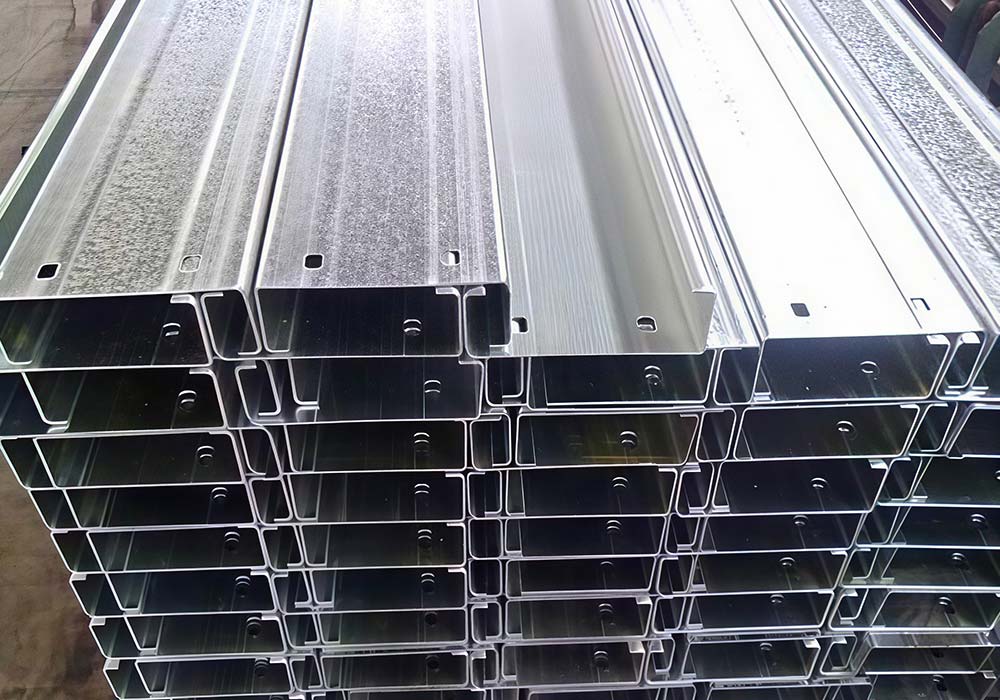
C-shaped steel is an open, thin-walled steel section made from hot-rolled or cold-rolled steel plates/strips through multiple roll forming processes and then cut to length. Its cross-section resembles the letter “C,” with the web, side flanges, and inwardly rolled edges forming a highly efficient load-bearing section. It is widely used in purlins, wall beams, and various supporting components of steel structures. The product conforms to GB/T 6728-2025 “Cold-formed Steel Sections for Structural Use” (implemented from March 2026, integrating and replacing GB/T 6723-2017 and GB/T 6728-2017), and can also be supplied according to international standards such as ASTM, EN, JIS, and AS/NZS.
Material and Surface Treatment
| Standard / System | Common Grades | Yield Strength (Reference) |
|---|---|---|
| China GB | Q235B, Q355B (low-alloy high-strength steel) | ≥235 / ≥355 MPa |
| USA ASTM | A36, A572 Gr.50, A653 (galvanized sheet) | ≥250 / ≥345 / ≥350 MPa |
| Europe EN | S235JR, S275JR, S355JR (EN 10025-2) | ≥235 / ≥275 / ≥355 MPa |
| Japan JIS | SS400, SS490 (JIS G3101) | ≥245 / ≥295 MPa |
| Galvanized sheet | S350GD+Z, DX51D+Z (EN 10346 / GB/T 2518) | By grade |
Structural Features
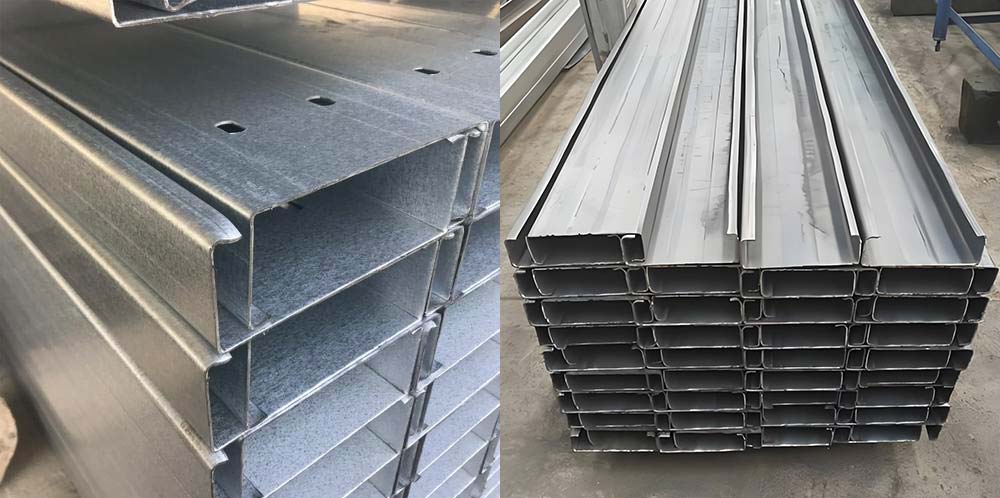
The cross-section consists of four parts: web (H), flanges (B), inwardly rolled edges (C), and wall thickness (t). Corners are rounded with a radius R. Specifications are marked as H×B×C×t, for example, C160×60×20×2.5 indicates a web height of 160 mm, flange width of 60 mm, rolled edge of 20 mm, and wall thickness of 2.5 mm.
- Rolled edges significantly improve the local buckling capacity of the flanges, making full use of the strength of thin-walled sections;
- Open sections have high bending efficiency but relatively weak torsional resistance, and are usually used in conjunction with tie rods and struts in design;
- Continuous roll forming (10–18 passes) results in high dimensional accuracy and good cross-sectional consistency.
Product Parameters
| Parameter | Common Range |
|---|---|
| Web depth, H | 40–400 mm (commonly 80–300 mm) |
| Flange width, B | 30–100 mm (commonly 40–80 mm) |
| Lip width, C | 10–30 mm (commonly 15–20 mm) |
| Thickness, t | 1.0–6.0 mm (1.5–3.5 mm for purlins) |
| Cut-to-length | 6–12 m, customizable |
| Dimensional tolerance | Web depth ±0.5–2.0 mm; flange ±1–2 mm; thickness ±0.05–0.25 mm (per agreed standard) |
| Mechanical properties | Q235B: yield ≥235 MPa, tensile 370–500 MPa, elongation ≥26%; Q355B: yield ≥355 MPa |
| Applicable span | Approx. 1.5–7.5 m (subject to structural calculation) |
Common Models (Reference)
| Model | Web Depth H (mm) | Flange Width B (mm) | Lip C (mm) |
|---|---|---|---|
| C80×40×15 | 80 | 40 | 15 |
| C100×50×20 | 100 | 50 | 20 |
| C120×50×20 | 120 | 50 | 20 |
| C140×50×20 | 140 | 50 | 20 |
| C160×60×20 | 160 | 60 | 20 |
| C180×70×20 | 180 | 70 | 20 |
| C200×70×20 | 200 | 70 | 20 |
| C220×75×20 | 220 | 75 | 20 |
| C250×80×20 | 250 | 80 | 20 |
| C300×80×20 | 300 | 80 | 20 |
Notation: H = web depth, B = flange width, C = lip width, t = wall thickness; designation format is H×B×C×t (mm), e.g. C160×60×20×2.5.
Product Features
1. High Strength and Lightweight: Material is efficiently distributed across the cross-section, saving 20-30% of steel compared to hot-rolled steel for the same load-bearing capacity;
2. Complete Specifications: Heights from 80-300 mm are available, and wall thickness, length, and openings can be customized;
3. Corrosion Resistance and Durability: Galvanized products have a service life of 15-25 years under normal conditions. In coastal/high-humidity environments, the zinc layer can be increased or zinc-aluminum-magnesium alloys can be used;
4. Quick Installation: Factory pre-drilling and corner cutting allow for on-site bolt connection, eliminating the need for welding and enabling rapid construction;
5. Straight and Aesthetically Pleasing: Cold-bent surfaces are smooth and dimensionally precise, facilitating panel fitting;
6. Green and Environmentally Friendly: 100% recyclable steel, meeting green building and sustainable development requirements.
Application Areas
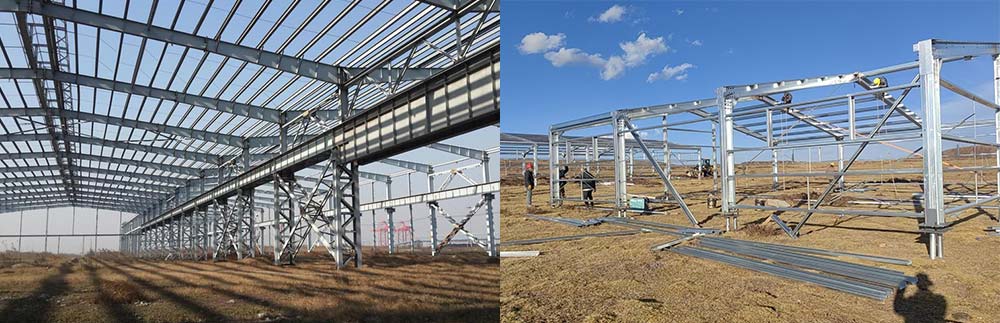
1. Steel Structure Buildings: Roof purlins and wall beams for industrial plants and warehouses;
2. Public and Commercial Buildings: Enclosure support systems for shopping malls, stadiums, stations, and convention centers;
3. New Energy: Photovoltaic power station brackets, photovoltaic carports, and rooftop photovoltaic rails;
4. Civil and Temporary Buildings: Steel structure houses, mezzanine secondary beams, carports, awnings, and greenhouses;
5. Industrial Equipment: Warehouse racks, cable trays, equipment racks, and conveyor line supports;
6. Transportation and Others: Vehicle components, modular housing, and decorative framing, etc.
Selection and Ordering Tips
- The model and wall thickness must be determined based on structural calculations according to the actual load (dead load, snow load, wind load);
- The purlin spacing should match the allowable span of the corrugated steel sheet, sandwich panel, and other cladding panels;
- C-shaped steel is preferred for walls and small-span roofs, while Z-shaped steel can be considered for large-span, steep-slope roofs;
- For corrosive environments, the zinc coating weight and anti-corrosion process should be clearly defined;
- Openings and chamfering should preferably be completed in the factory to avoid damaging the coating on-site.
Our Global Application Industries